
How Micrograms of Iodine, B12, and Vitamin D Run the Body
How can an amount of matter almost too small to see determine the function of an entire human being? How can a speck of a nutrient influence the transition from well to sick to dead.
The answer is that micronutrients are not important because of their mass. They are important because of their information, catalytic power, molecular location, and biological leverage.
We build a human body from pounds of protein, kilograms of water, hundreds of grams of minerals, and enormous quantities of carbohydrate and fat over a lifetime.
And yet some of the molecules that determine whether that magnificent biological machine works properly arrive not by the gram, but by the microgram.
A microgram is one-millionth of a gram.
Put another way:
1 gram = 1,000,000 micrograms.
The Magnificent Power of the Infinitesimal: Why Micrograms Matter
Yet biology has learned to accomplish extraordinary things with these almost unimaginably small quantities. Vitamins and trace minerals frequently serve as enzyme cofactors, coenzymes, components of hormones, participants in electron transfer, and regulators of gene expression. They do not necessarily provide the bricks and mortar of the body. They often provide the switches, keys, catalysts and instructions that tell the bricks and mortar what to do. (PubMed Central (PMC))
And that distinction changes everything.

Iodine: 150 micrograms that can influence an entire organism
The adult recommendation for iodine is approximately 150 µg per day. Iodine is incorporated into the thyroid hormones T4 and T3, which participate in the regulation of metabolism, growth and development. (PubMed Central (PMC))
What does 150 µg actually mean?
It is:
0.000150 gram
0.15 milligram
0.0000053 ounce
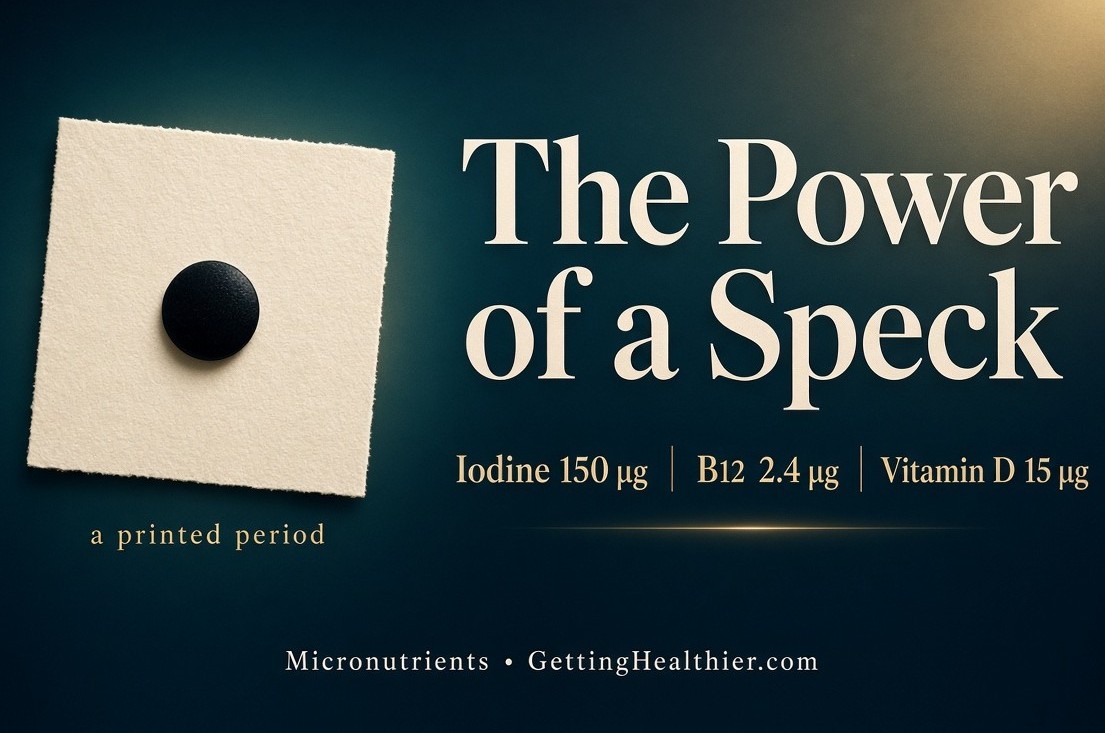
If 150 µg of elemental iodine could be formed into a compact little sphere, its diameter would be roughly 0.4 millimeter.
It would be on the general scale of a small printed period on this page.
But now comes the astonishing part.
Using iodine’s atomic weight of about 126.9 and Avogadro’s number, that almost invisible 150 µg contains approximately:
711,800,000,000,000,000 iodine atoms.
About 7.1 × 10¹⁷ atoms. 711 quadrillion atoms.
So “microscopic amount” does not mean “few molecules.”
To the human eye, 150 µg is almost nothing.
To chemistry, it is an astronomical population of atoms.
And the thyroid possesses specialized machinery for capturing iodine, concentrating it and incorporating it into thyroid hormone. The iodine-replete adult body contains only about 15–20 mg of iodine, with roughly 70–80% concentrated in the thyroid. (PubMed Central (PMC))
This is biological concentration with a purpose.
A trace element scattered randomly through 70 kilograms of tissue might accomplish little. Put it into precisely constructed hormone molecules, deliver those molecules to receptors throughout the body, and suddenly that tiny quantity has enormous physiological reach.
That is biological leverage.
Iodine and the developing brain
The most dramatic illustration occurs during fetal and early childhood development.
Severe iodine deficiency can impair thyroid hormone production and produce profound abnormalities of growth and neurodevelopment. Historically, severe deficiency was associated with endemic cretinism—today more appropriately described in terms of severe iodine-deficiency disorders and neurodevelopmental impairment. Adequate maternal iodine and thyroid hormone are particularly important during fetal brain development. (PubMed Central (PMC))
A speck of iodine during the crucial developing “window” for an infant can bring that child up to their genetic potential in IQ or render that child an irremediable retard. That is one of the reasons why I support VitaminAngels.org. They provide 70 million vitamin/mineral pills per year to pregnant women and young children in 70 countries around the world. Far easier to prevent a problem than try heroic efforts to fix the problem once entrenched.
Nutrition cannot manufacture genius. Genetics, environment, education and countless other factors determine intellectual development.
But severe iodine deficiency during critical developmental periods can prevent a developing brain from reaching its biological potential.
That may be an even more remarkable statement.
A quantity of iodine comparable in size to a punctuation mark can participate in determining whether billions of developing neurons receive the hormonal signals necessary for normal development.
Iodine / thyroid → 90 Essential Nutrients for Health
Vitamin B12: even smaller
The current U.S. adult RDA for vitamin B12 is 2.4 µg per day.
That is:
0.0000024 gram.
You would need about 417,000 daily B12 allowances to make one gram.
And yet even 2.4 µg of vitamin B12 contains approximately:
1,066,000,000,000,000 molecules
—roughly one quadrillion B12 molecules.
That gives us an entirely different perspective on the word tiny.
B12 participates in critical biochemical reactions involving one-carbon metabolism, DNA synthesis, red blood-cell production and nervous-system function. B12 deficiency can therefore produce megaloblastic anemia and neurological abnormalities. The body also stores B12 remarkably efficiently—adult stores can exceed 2,500 µg, explaining why deficiency can take years to appear after absorption or intake becomes inadequate. (PubMed Central (PMC))
This illustrates an important principle:
The body does not need a pound of a key to open a lock.
A key works because of its shape and because it fits the right lock.
Much of micronutrition operates similarly.

Vitamin D: a speck that becomes a signal
Vitamin D provides another beautiful example.
For adults aged 19–70, the U.S. RDA is 600 IU, equivalent to 15 µg. For adults over 70, it is 800 IU, or 20 µg. (PubMed Central (PMC))
5,000 IU vitamin D3 = 125 µg.
That is only:
0.000125 gram.
Yet 125 µg of vitamin D3 represents approximately:
196,000,000,000,000,000 molecules.
Nearly 200 quadrillion molecules.
And vitamin D illustrates why thinking of vitamins merely as tiny dietary ingredients understates their sophistication.
Vitamin D is converted into biologically active forms, and the active hormone binds the vitamin D receptor (VDR). The activated receptor interacts with regulatory regions of DNA and alters transcription of networks of genes. (PubMed Central (PMC))
Thus a molecule weighing essentially nothing at the kitchen scale can ultimately change what a cell does.
That is extraordinary.
Why doesn’t the body need more?
Because many micronutrients participate in processes rather than being consumed as bulk materials.
Imagine an automobile factory.
Steel is required by the ton.
Paint is required by the gallon.
But the computer code controlling the robotic assembly line might weigh nothing at all.
Remove the steel and you cannot build automobiles.
But corrupt a few lines of the software and the entire factory can stop.
Macronutrients are often the materials.
Micronutrients are frequently part of the machinery and control systems.
An enzyme may process enormous numbers of substrate molecules while its vitamin-derived cofactor participates repeatedly in the chemistry. A receptor activated by a signaling molecule can initiate cascades involving many downstream molecules. A transcription factor can influence the production of enormous numbers of proteins.
This creates molecular amplification.
One signal affects many genes.
One enzyme facilitates many reactions.
One hormone molecule initiates a signaling pathway.
One micronutrient deficiency can therefore impair an entire biochemical network.
That is why nutritional importance is emphatically not proportional to weight.
The paradox of micronutrition
We should never confuse smallness with insignificance.
The human body is constructed on scales that our eyes cannot comprehend.
A day’s iodine requirement could resemble a punctuation mark.
A day’s B12 requirement is dramatically smaller still.
But within those seemingly insignificant specks reside hundreds of trillions—or quadrillions—of atoms or molecules. Biology captures them, transports them, concentrates them and places them into molecular machinery with astonishing precision.
A few micrograms of iodine become part of hormones capable of influencing metabolism and development.
A few micrograms of B12 help maintain biochemical reactions necessary for blood and nervous-system function.
Microgram quantities of vitamin D ultimately participate in a hormone-receptor system capable of modifying gene transcription.
The miracle is not that the human body needs so much nutrition.
The miracle is how much biology can accomplish with so little.
A handful of protein can become muscle.
A glass of water can replenish circulation.
But a speck of iodine can help construct a hormone.
A nearly invisible quantity of B12 can sustain indispensable enzyme systems.
And a dusting of vitamin D can ultimately communicate with the genome.
Nutrition teaches us one of nature’s most elegant lessons:
Power is not always measured by quantity. Sometimes it is measured by precision.
And perhaps that is the most beautiful definition of a micronutrient.
Your mission, should you choose to accept it, is to optimize your body’s biochemistry through nutrition. The result can be a long, energetic, vibrant life.
Minerals / soil depletion → The Great Mineral Robbery
Essential nutrients: adult RDA or AI
| Nutrient | Adult men | Adult women | Type | Principal role |
|---|---|---|---|---|
| Vitamin B12 | 2.4 µg | 2.4 µg | RDA | DNA synthesis, methylation, nerves, red blood cells |
| Vitamin D | 15 µg (600 IU); 20 µg (800 IU) age 71+ | Same | RDA | Calcium metabolism, bone, muscle, gene regulation |
| Chromium | 35 µg age 19–50; 30 µg age 51+ | 25 µg; 20 µg age 51+ | AI | Macronutrient metabolism* |
| Biotin (B7) | 30 µg | 30 µg | AI | Carboxylase enzymes; fat/glucose metabolism |
| Molybdenum | 45 µg | 45 µg | RDA | Enzyme cofactor |
| Selenium Selenium Benefits | 55 µg | 55 µg | RDA | Selenoproteins, thyroid metabolism, antioxidant enzymes |
| Vitamin K Vitamin K For Cancer Patients | 120 µg | 90 µg | AI | Blood clotting, bone proteins |
| Iodine | 150 µg | 150 µg | RDA | Thyroid hormones |
| Folate (B9) | 400 µg DFE | 400 µg DFE | RDA | DNA synthesis, methylation, cell division |
| Vitamin A | 900 µg RAE | 700 µg RAE | RDA | Vision, immunity, epithelial differentiation |
| Copper | 900 µg | 900 µg | RDA | Iron metabolism, connective tissue, enzymes |
| Thiamin (B1) | 1.2 mg | 1.1 mg | RDA | Carbohydrate/energy metabolism |
| Riboflavin (B2) | 1.3 mg | 1.1 mg | RDA | FAD/FMN energy reactions |
| Vitamin B6 | 1.3 mg age 19–50; 1.7 mg age 51+ | 1.3 mg; 1.5 mg age 51+ | RDA | Amino-acid metabolism, neurotransmitters |
| Manganese | 2.3 mg | 1.8 mg | AI | Enzyme cofactor |
| Pantothenic acid (B5) | 5 mg | 5 mg | AI | Coenzyme A |
| Iron | 8 mg | 18 mg age 19–50; 8 mg age 51+ | RDA | Hemoglobin, oxygen transport, enzymes |
| Zinc | 11 mg | 8 mg | RDA | Hundreds of enzymes, DNA, immunity |
| Niacin (B3) | 16 mg NE | 14 mg NE | RDA | NAD/NADP energy metabolism |
| Vitamin E | 15 mg | 15 mg | RDA | Membrane antioxidant |
| Vitamin C | 90 mg | 75 mg | RDA | Collagen, antioxidant activity, iron absorption |
| Magnesium → Magnesium Deficiencies | 400–420 mg | 310–320 mg | RDA | ATP reactions, muscle, nerves, hundreds of enzymes |
| Choline | 550 mg | 425 mg | AI | Cell membranes, acetylcholine, methylation |
| Phosphorus | 700 mg | 700 mg | RDA | ATP, bone, DNA, phospholipids |
| Calcium | 1,000 mg; 1,200 mg age 71+ | 1,000 mg; 1,200 mg age 51+ | RDA | Bone, muscle contraction, signaling |
| Potassium | 3,400 mg | 2,600 mg | AI | Membrane potential, muscle and nerve function |
| α-Linolenic acid (omega-3) | 1.6 g | 1.1 g | AI | Essential fatty acid |
| Linoleic acid (omega-6) | 17 g age 19–50; 14 g age 51+ | 12 g; 11 g age 51+ | AI | Essential fatty acid |
| Protein | 0.8 g/kg body weight | 0.8 g/kg | RDA | Supplies the nine essential amino acids |
“the enormous biological power of the infinitesimal.”
Selected National Library of Medicine / PMC reading
Micronutrients in Health and Disease — PMC — an excellent overview of micronutrients as cofactors, coenzymes, antioxidants and regulators.
Biomarkers of Nutrition for Development: Iodine Review — PMC — detailed review of iodine biology and nutritional assessment. (PubMed Central (PMC))
Iodine: Its Role in Thyroid Hormone Biosynthesis and Beyond — PMC — particularly useful for explaining how tiny iodine intakes become thyroid hormones.
Iodine Nutrition in Pregnancy and Lactation — PMC — excellent discussion of iodine and fetal neurodevelopment.
Vitamin B12 and Older Adults — PMC — B12 requirements, absorption, storage and deficiency.
The Vitamin D Receptor and Regulation of Gene Expression — PMC — especially fascinating for the concept of micronutrients influencing gene transcription.


